Monospace: LeRoy Stevens Interview
Exhibition: Record of Incoming Calls to Personal Cell Phone (Between 7am and 7pm, January 23 through February 22)
Karin: Where did the Record of Incoming Calls… start? Was it an
idea or title first, or maybe the phonebill?
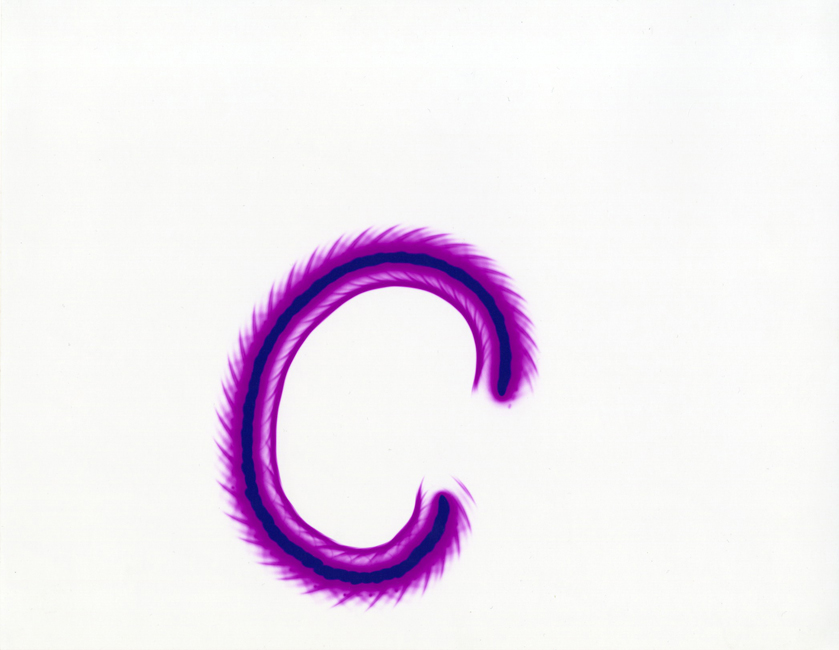
LeRoy: The project began playfully in a color photo lab. I placed
my phone onto a piece of photo paper and then called it from a
nearby payphone. When the cell phone rang it vibrated across the
paper while flashing, thus exposing it. I returned to the lab to
process the photograph and was amazed by the result.
It didn’t seem that interesting to make the phone calls myself,
but instead to let the natural flow of incoming calls from others
determine the images. I used the phone bill, one billing month, as
the amount of time the project would take place. Each morning
before 7 am, I placed the phone onto a sheet of photo paper within
the lab and at 7 pm would return to process the photograph that
had been made that day.
Karin: So, the images are produced in the darkroom, but without the
use of camera or film. What is it that excites you in that type of
photographic experimentation?
LeRoy: It was about a direct relationship between the activity and
a 1 to 1 document made from that process. I like the immediacy of
experimentation and result that photography yields, and in
projects such as this one, an emphasis in elements most basic to
photography: light, time, and photosensitive material. Though I
use photography often in my work, I’ve never wanted to be a
photographer proper, but rather use photography to suit specific
projects.
Karin: I like how the movement of the phone creates these purple
wormlike shapes with “hair” from each ring and then the occasional
blue “heads“ from the voicemails. You could do a year long project
and probably none of the images would look the same … or is it
possible to get two identical images?
LeRoy: I suppose it is possible for two of the images to be very
similar, but certainly not identical. It’s interesting how people
often refer to the marks in the photographs figuratively as worms
or as fishing lures.
Karin: Fishing lures to catch you in a phone conversation? I am
joking. But slightly more seriously – there is nothing unusual
about not picking up your phone in New York for a month – people
love playing phone tag. Did anybody file a missing person’s report
for you during that month?
LeRoy: No, I typically called everyone back at the end of the day.
As the month progressed I began to receive fewer phone calls
though.
recently gotten my first cell phone and was annoyed by the
complete accessibility you gain when you have a cell phone. A
person is expected to be available all the time. Doing this
project was a way for me to forfeit that responsibility. The time
of day in which the project took place, 7 am to 7 pm, reflected my
phone “plan” as those were the hours within the plan that in
addition to the standard monthly fee, I was responsible for
paying. After 7 pm, there were no additional charges no matter
who calls you and vice versa. Besides creating a visual
representation of my phones daily activity, I was also able to
free myself of additional payments and increase privacy. This is a
common thread in a lot of my work; projects that operate under
multiple conditions and develop meaning through everyday
activities.
Karin: I didn’t realize you got your first cell phone around the
same time. Very spot on response to the new demand for constant
availability with monthly fees – you reverse the ritual of
switching on the phone in the morning, block out the payable hours
and end up with a work of art. Do you still hate being available
or have you found other ways to ignore it?
LeRoy: I still try to avoid phone time, but am finding myself
surprisingly fond of text messaging. Although it can be vague,
text messages can also be a very concise and effective way to
communicate. When writing a text message you are forced to convey
your thoughts within a limited number of characters (160). This
limitform encourages abbreviations and is furthering a new
strange language. I love the inherent potential for word play,
multiple meanings and jokes – and appreciate the time you have to
consider a thoughtful response.
it though…
Karin: Never say never! But you could expose the paper to different
glowing objects. I was just reading about August Strindberg’s
Celestographs from 1894, where he put photographic paper out on
his windowsill at night, believing that the light of the stars
could be captured on paper. Apparently he turned to intense
experimenting with photography when his literary creativity had
reached a deadlock.
LeRoy: I only know Strindberg’s work vaguely, but appreciate his
dabbling in other media when at a creative standstill and can
relate to his method; photography less about the act of framing an
object and more around framing an activity. When making these
images, I was interested in producing photographs that operate as
carriers of an activity, rather than representations of one. A
blank photograph from this series might be a good example – though
visually the same, a day when no phone calls were received is
different from a blank photograph made by other means.
LeRoy: A question that arises in work that relies primarily on
titles and an unseen process* is that of belief – do we believe in
the way these works are produced and is it necessary to the
understanding of the work?
Karin: I think knowing the method is crucial for understanding your
work. From just observing the reactions of the people, there was a
huge difference between them looking at the photos and looking at
them after hearing the description: simply because it is difficult
to guess how the results are achieved. The issue of believing the
“behind the scene” process didn’t come up once – none of them
suspected that the described method of producing the photos would
be false. But even if they did – that’s fine too. Don’t you think?
LeRoy: I agree that knowing the method is crucial to understanding
this work. As for believability, if a person didn’t believe the
process that would be ok too – it could exist meaningfully as an
idea.
Karin: I feel like we could start wrapping it up. Tempted to steal
Tom Friedman’s title and call this interview “1000 Hours of
Staring”, but no one would believe that. Right?
LeRoy: Haha … it’s been at least a thousand hours – in fact it’s
been 1,148 hours since we began this interview. The format, email
correspondence over 2 ½ months seems unique for it’s slowness and
right in line with the format of Monospace; a continuing series of
group exhibitions followed by a single work.
* A few examples of works that rely heavily on a title and feature
an aspect of process crucial to the work that remains unseen.
1. Jan Dibbets, “Robin Redbreast’s Territory/Sculpture 1969,” over a
period of time the artist gradually extends a birds territory by
changing the placement of a pole in a park- documented through
photographs and text in an artist’s book.
2. A glass bottle w/ brownish water inside titled, “Bottle of Water
From the Rhine w/ 10,000 Pollutants Added,” by Joseph Beuys.
3. A seemingly blank sheet of drawing paper titled, “1000 Hours of
Staring,” by Tom Friedman.